¶ Project Intro (SIGA API)
SIGA API is a modular FastAPI backend organized by business domains (each module has controllers, models, schemas, and services). Routing is centralized per module and aggregated at startup, and database changes are managed with Alembic migrations. The app exposes REST endpoints with standardized responses and permission checks.
¶ Quick pointers
- Entry point and app boot:
main.py - Developer guidelines:
DEV_Readme.md - Setup/Run basics:
README.md - Modular codebase:
app/
¶ Structural architecture
- FastAPI (API layer): Initializes the application, middleware, and route registration (
main.py). Each domain exposes a router that’s included at startup. - Celery (background jobs, if enabled): Executes long-running tasks outside request/response cycles; typically runs as a separate worker process.
- Redis (cache/broker, optional): Used as a cache and/or Celery broker depending on environment settings; connection is initialized on app startup.
- Flower (monitoring, optional): Web UI to monitor Celery workers and task queues.
- MinIO (object storage, optional): S3-compatible storage for files and uploads if configured.
- Database + Alembic: SQLAlchemy models with Alembic migrations for schema changes.
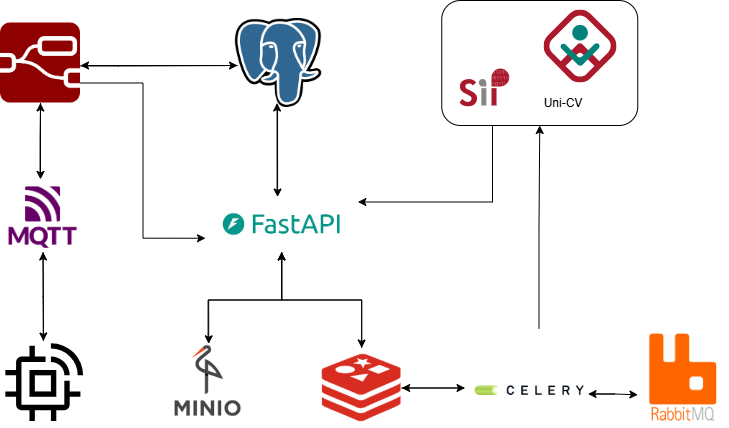
¶ Folder overview
¶ app/core/
Shared infrastructure and cross‑cutting services used across the app:
config.py: environment settings and configuration loading.database.py: database session/engine setup.logging_config.py: logging configuration and logger setup.flower_config.py: Flower (Celery monitoring) configuration.minio_service.py: MinIO/S3 client setup and helpers.celery/: Celery app configuration and task wiring.celery.py: Celery app instance.celery_db.py: Celery DB integration helpers.tasks/: background tasks (email, sync, DLQ, etc).
¶ app/modules/
Business-domain modules. Each module follows the same structure:
config/: route registration, module-specific settings, Alembic hooks.controllers/: FastAPI endpoints (request/response layer).models/: SQLAlchemy ORM models.schemas/: Pydantic request/response schemas.services/: business logic and integrations.- Some modules may include
decorators/, **security/**for specialized needs.
¶ Database migrations (alembic/)
Alembic manages schema migrations for the SQLAlchemy models. This folder contains the migration environment and all generated migration scripts.
¶ alembic/env.py
Alembic runtime configuration and bootstrap:
- Loads the app’s DB settings (URL, metadata).
- Connects to the database and configures the migration context.
- Supports offline/online migration execution.
- Points Alembic to the SQLAlchemy
Base.metadatasoalembic revision --autogeneratecan detect model changes. - Important: for a model to be detected by Alembic, its module must be imported in
alembic/env.py(as shown by the module-level imports). If a module isn’t imported, its models won’t be included inBase.metadataduring autogeneration.
¶ alembic/versions/
All migration scripts live here:
- Each file is a single schema change (create/alter/drop tables, constraints, indexes, etc.).
- Filenames start with a revision ID followed by a short description.
- Alembic uses these revision IDs to track migration order and dependencies.
¶ Config & environment files
¶ dev_requirements.txt
Development-only dependencies for local work (testing, Celery/Redis, MinIO, etc.).
¶ requirements.txt
Runtime/production dependencies (includes Gunicorn, uvloop, Flower).
¶ .env
Local environment values (DB, SMTP, Redis, Celery, MinIO, secrets). Do not commit.
¶ .env.example
Template of required environment variables with placeholders to create a local .env.
¶ .gitignore
Git ignore rules for caches, builds, virtualenvs, logs, and local secrets.
¶ app/modules/basic/
Foundational/authentication and shared platform features:
- Auth & security: login, tokens, permissions, and access control.
- Core entities: users, groups, roles, cards, routes, logs, audits, files.
- Utilities: caching, auditing, permission decorators, and security helpers.
- Purpose: acts as the base module other domains rely on.
¶ app/modules/protocol/
Integration-focused domain (SII/Protocol):
- Controllers: endpoints for SII/protocol-related operations (
sii_controller.py). - Models/Schemas: data structures for docentes/funcionários and related payloads.
- Services: external API integration logic (
sii_services.py). - Purpose: bridges SIGA with external protocol/SII systems.
¶ app/modules/basic/ (file overview)
¶ config/
routes.py: aggregates and exposes all Basic module routers.alembic.py: imports Basic models so Alembic can detect them for migrations.
¶ controllers/
API endpoints for core platform features:
- Note: controllers should stay thin; reusable logic must be moved into services.
auth_controller.py: login/authentication flows.user_controller.py: user CRUD and profile ops.group_controller.py: groups and group membership.route_controller.py: route/permission management.card_controller.py,card_type_controller.py: card and card type handling.bio_controller.py: biometrics endpoints.docente_controller.py,funcionario_controller.py: academic/staff endpoints.log_controller.py,dlq_controller.py: logs and failed tasks (DLQ).minio_controller.py: file/storage endpoints.database_controller.py: DB utilities/health endpoints.
¶ models/
SQLAlchemy ORM entities:
- Core:
user_model.py,group_model.py,route_model.py - Auth/permissions:
group_permission_model.py,user_group_model.py - Cards/biometrics:
user_card_model.py,card_type_model.py,user_biometry_model.py - Audit/logs/files:
audit_model.py,log_model.py,file_model.py - Other:
user_type_model.py,dlq_model.py
¶ schemas/
Pydantic request/response models for controllers:
auth.py, user_type.py, group.py, route.py, card.py, card_type.py, bio.py, docente.py, funcionario.py, audit.py.
¶ services/
Business logic and integrations:
auth_service.py: auth, tokens, login flows.user_service.py: user-related operations.permission_service.py: permission checks and rules.route_service.py: route/permission management.
¶ security/
auth_security.py: security helpers (token verification, guards).
¶ decorators/
audit_decorator.py: audit logging.cache_decorator.py: caching helpers (e.g., Redis).permission_decorator.py: permission enforcement.
¶ Small examples
¶ app/modules/basic/config/alembic.py
Alembic discovers models via imports. Example:
from ..models.user_model import User
from ..models.group_model import Group
¶ app/modules/basic/config/routes.py
Routes for the Basic module:
from ..controllers.user_controller import router as user_router
from fastapi import APIRouter

basicRoutes = APIRouter()
basicRoutes.include_router(user_router, prefix="/v1/basic", tags=["Users"])
¶ How endpoints are defined
Endpoints are declared with FastAPI decorators on a module router, and then aggregated in config/routes.py. They commonly use Depends for auth/db injection and shared decorators (e.g., caching).
Example (from auth_controller.py):
@router.get("/permissions", response_model=UniversalResponse, summary="Obter Permissões")
@cache_response(ttl=240, namespace="siga_permissions")
async def get_permissions(
        token_data: dict = Depends(validate_token),
        db: AsyncSession = Depends(get_db)
):
    # ...existing code...
¶ Endpoint decorators & parameters (example)
Example used:
@router.get("/permissions", response_model=UniversalResponse, summary="Obter Permissões")
¶ Decorators
@router.get("/permissions", ...): registers a GET endpoint at/permissionson this module router.response_model=UniversalResponse: enforces/serializes the output to the shared response schema.summary="Obter Permissões": short description shown in Swagger/OpenAPI docs.@cache_response(ttl=240, namespace="siga_permissions"): caches the response for 240 seconds under a namespace, reducing repeat DB calls.
¶ UniversalResponse (response wrapper)
UniversalResponse is the shared response schema used across controllers to keep API outputs consistent.
Controllers typically return either:
UniversalResponse.success_response(payload=...)for successful requests, orUniversalResponse.error_response(code=..., cause=..., message=...)for errors.
This ensures a uniform response structure for clients regardless of endpoint.
¶ Parameters
token_data: dict = Depends(validate_token): runs thevalidate_tokendependency; injects the decoded token data (auth guard).db: AsyncSession = Depends(get_db): injects a database session for the request lifecycle.
¶ Auditable models & log_audit_info
For auditable models, any endpoint that creates, updates, or deletes data must include:
log_audit_info: dict = Depends(get_log_audit_info)
This ensures audit metadata (user/ip) is captured and attached during the DB operation.
¶ Model conventions (prefix, Log, @auditable)
¶ Table name prefix (per module)
Each module should define a table name prefix and use it in __tablename__ for consistency (e.g., siga_, adoc_, afunc_, etc.).
This keeps tables grouped by domain and avoids naming collisions.
¶ Log base mixin
All models should inherit from Log (in addition to Base).
Log provides shared audit fields:
user_id,ip_addresstimestamp(auto-set on insert/update)status(soft delete viaACTIVE/INACTIVE)
It also registers SQLAlchemy events to automatically inject audit data from a request context.
¶ @auditable decorator
Only models that need audit history should be decorated with @auditable.
This enables the audit logging behavior, but is optional—not every model needs it.
Reference (from log_model.py):
// filepath: [log_model.py](http://_vscodecontentref_/1)
# ...existing code...
class Log:
    user_id = Column(Integer, nullable=True, index=True)
    ip_address = Column(String(45), nullable=True)
    timestamp = Column(DateTime(timezone=True), server_default=func.now(), onupdate=func.now(), index=True)
    status = Column(Enum(siga_Status_enum), default=siga_Status_enum.ACTIVE, index=True)

    def soft_delete(self):
        self.status = siga_Status_enum.INACTIVE

# ...existing code...
¶ Schemas & UniversalResponse
All endpoints return UniversalResponse for a consistent API shape.
The payload inside UniversalResponse must be defined by a Pydantic schema in app/modules/<module>/schemas/.
In practice:
- Controllers declare
response_model=UniversalResponse. - The actual data returned goes inside
payloadand should match a schema (e.g.,UserResponse,PermissionResponse, etc.).
¶ Alembic — Migrations (Essential)
Main commands:
alembic history          # list migration history
alembic upgrade head     # apply all pending migrations
alembic downgrade -1     # rollback the last migration
alembic check            # compare models vs database
Create a new migration:
# 1) Ensure the module is imported in alembic/env.py
# 2) Autogenerate the migration
alembic revision --autogenerate -m "short_description"

# 3) Review the generated file in alembic/versions/
# 4) Apply the migration
alembic upgrade head
Note: if the module isn’t imported in alembic/env.py, its models won’t be detected.